Most people assume creating a Facebook account takes five minutes. For many Indian users, it takes five attempts. Facebook's identity systems have grown significantly more sophisticated over the past several years, and the platform now applies layers of behavioral analysis, device recognition, and network-level scrutiny that can stop a new account before the profile photo is even uploaded. The result is a frustrating cycle of OTP failures, sudden checkpoints, and accounts restricted for no obvious reason.
The challenge cuts across different types of users. A freelance digital marketer in Hyderabad, a family-owned business in Surat trying to run its first ad campaign, a content creator in Delhi managing a growing audience - each faces the same underlying problem: Facebook's systems were not designed with India's telecom infrastructure, shared broadband environments, or prepaid SIM culture in mind. New facebook account creation in this context demands more preparation than the sign-up page suggests.
This guide covers the complete picture. It walks through every practical step of the account creation and facebook account verification india process, explains the technical and behavioral factors that determine whether a new account survives its first weeks, and offers a clear-eyed assessment of the market for purchasing established profiles - including how to approach it safely and what to avoid entirely.
Understanding Facebook Account Requirements in India
Facebook operates under a single global Terms of Service, but the lived experience of that policy varies considerably depending on where you are. In India, several structural features of the digital environment interact with Facebook's detection systems in ways that create friction unique to the region.
The platform's identity model is built around the assumption that each account represents one real person with consistent credentials, stable location signals, and predictable usage patterns. Indian users frequently present a different profile: multiple SIM cards, frequent device changes, widespread use of mobile data over fixed broadband, and network addresses shared across thousands of users on the same telecom node. None of these behaviors are inherently suspicious, but Facebook's automated systems can read them as inconsistencies that warrant closer scrutiny.
When you create facebook account india, the platform begins building a trust profile from the first interaction. It records the device fingerprint, the IP address range, the phone number's carrier and registration history, and the sequence of actions you take after sign-up. Accounts that immediately exhibit patterns associated with coordinated inauthentic behavior - mass messaging, bulk friend requests, repeated ad account creation - are flagged at the algorithmic level before any human review occurs.
It is also worth understanding that Facebook distinguishes sharply between personal profiles, Pages, and Business Manager accounts. A personal profile is the foundational identity layer. Pages and ad accounts sit on top of it, inheriting trust signals from the underlying profile. A new personal account with no behavioral history cannot reliably support advertising activity right away - the trust score simply hasn't been established yet. This architectural reality is why the warm-up period, covered later in this guide, is not optional advice but a practical necessity.
- Facebook logs device fingerprint, IP address, and carrier data from the moment of sign-up
- Shared mobile network addresses used by Indian telecom providers can trigger automated scrutiny
- Personal profiles, Pages, and Business Manager accounts have separate trust levels within the platform
- New accounts that immediately perform high-volume actions are among the most frequently restricted
- India's prepaid SIM ecosystem and frequent device switching can appear inconsistent to Facebook's identity systems
Step-by-Step Guide to New Facebook Account Creation in India
Getting through account creation cleanly is not difficult once you understand what Facebook's system is actually evaluating. The goal is to present a coherent, consistent identity signal across every data point the platform collects - from the phone number you register to the network you're using when you first log in.
Choosing the Right Information and Credentials
Start with your phone number. Facebook uses OTP-based verification as the first identity gate, and the quality of that phone number matters beyond simply receiving a text message. Numbers associated with very recent SIM activations, numbers that have been used to register multiple Facebook accounts previously, or numbers linked to known bulk registration patterns are more likely to trigger additional verification steps. A postpaid number or a prepaid SIM with several months of usage history generally performs better here. If you're using a prepaid number, ensure it has been active long enough to show normal usage patterns with your carrier.
For your email address, use a legitimate provider - Gmail and Outlook are the most widely accepted. Disposable email addresses from temporary mail services are recognized and flagged. Your email serves as a recovery path and a secondary identity signal, so it should be an address you actively manage.
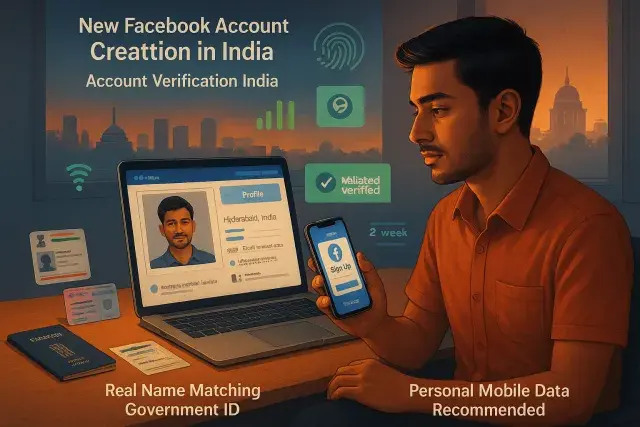
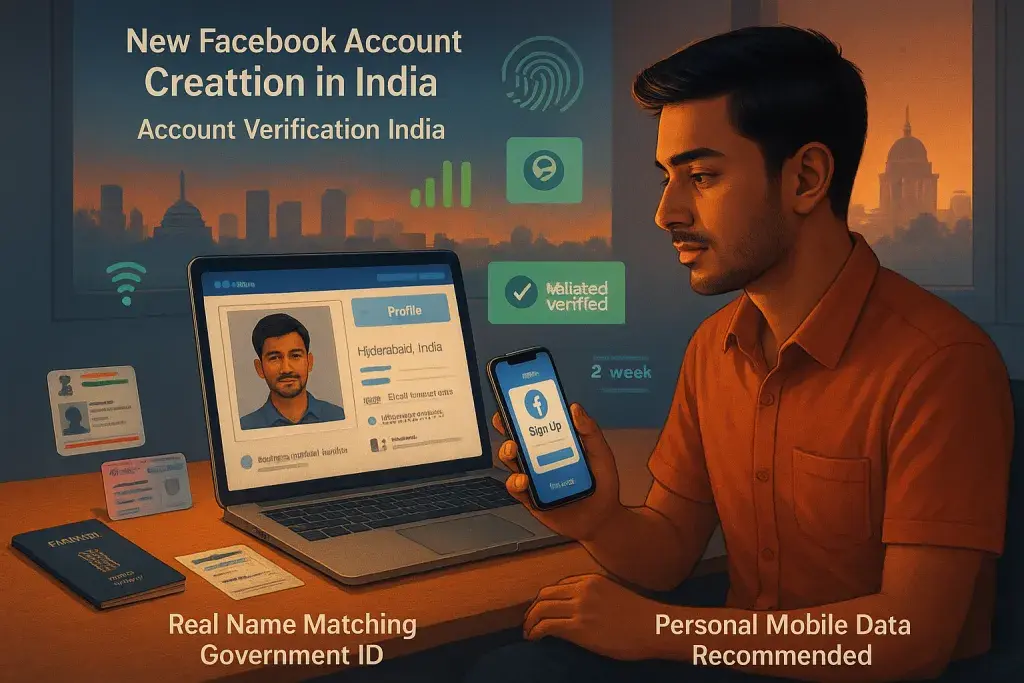
Your name should match what appears on your government-issued identification. This is not merely about aesthetics - Facebook's automated systems flag names that pattern-match to known fake account naming conventions. Unusual formatting, keyboard character substitutions, or names that appear machine-generated are associated with higher restriction rates. Use your real name as it would appear on an Aadhaar card or passport.
- Select a mobile number with a usage history of at least several months
- Use a personal, non-disposable email address from a reputable provider
- Enter your full real name consistent with your government-issued identification
- Provide an accurate date of birth matching your official documents
- Create a strong, unique password immediately at registration
- Complete the OTP step promptly without excessive retries
Completing Your Profile to Build Trust Signals
Facebook's algorithm evaluates new accounts not just at creation but continuously during the first several weeks. A profile that looks human - with a genuine photo, real location data, and filled-in personal details - generates a fundamentally different trust signal than a sparse, incomplete profile that immediately begins performing actions. Completing your profile thoroughly is one of the most effective steps you can take to reduce early restriction risk.
Upload a real photograph of yourself as your profile picture. Stock images, AI-generated portraits, and logos in place of personal photos are all associated with inauthentic account patterns. Your cover photo, while optional, adds an additional layer of perceived authenticity. Fill in your city and state - for Indian users, adding accurate local information in the About section helps establish geographic consistency between your profile data and your network location signals.
Add work history, education, and a brief bio if they reflect your real background. These fields are not required, but accounts that populate them appropriately are treated differently by the platform's automated systems than accounts that leave everything blank. Follow a small number of public pages relevant to your actual interests before beginning any business activity. This establishes a behavioral baseline that looks organic rather than purpose-built.
- Use a genuine personal photograph, not a logo or stock image
- Add accurate city and state information reflecting your actual location in India
- Fill in work history, education, and bio fields with real information where possible
- Follow a handful of relevant public pages as part of initial engagement
- Avoid sending friend requests in bulk during the first 48 hours after creation
- Do not immediately join a large number of groups or post in rapid succession
Device and Network Best Practices for Indian Users
The device and network conditions under which you create and first use a Facebook account have a direct impact on how the platform classifies that account. Facebook collects device-level identifiers alongside network data, and it maintains associations between devices and account histories - including histories of previously restricted or banned accounts on the same device.
Use personal mobile data for account creation rather than a shared office Wi-Fi or public network. Shared broadband connections in co-working spaces, offices, and commercial establishments route multiple users through the same IP address, and if any prior Facebook account associated with that address has been flagged, your new account may inherit that association. Personal 4G or 5G data on your own SIM card provides a cleaner, more individualized network signature.
Avoid VPNs during account creation and during the initial warm-up period. VPN usage is a known trigger for Facebook's additional verification flows, and accounts created through VPN connections are disproportionately likely to be asked for identity documentation before they can proceed. If you use a VPN for other purposes, disable it before beginning the registration process.
| Factor | Recommended Practice | Risk If Ignored |
|---|---|---|
| Internet Connection | Use personal mobile data (4G or 5G) | Shared IP may be associated with flagged accounts |
| Device | Use a device with no history of banned accounts | Device fingerprint may trigger automatic restriction |
| VPN Usage | Disable VPN before and during account creation | Forced identity verification or account checkpoint |
| App Version | Install the latest official Facebook app | Outdated versions may generate unusual session signals |
| Browser (if using desktop) | Use an updated browser with cleared cookies | Old session data may conflict with new account registration |
Facebook Account Verification in India: What It Means and How to Pass It
The phrase "account verification" covers three distinct processes on Facebook, and Indian users encounter all three depending on their situation. Conflating them leads to confusion and missed steps. Understanding each separately is the clearest path through this part of the process.
OTP and Phone Number Verification
OTP verification via SMS is the baseline step for all new accounts. Facebook sends a six-digit code to your registered mobile number, and you must enter it within the platform's time window. For most Indian users on major carriers, this step is straightforward. Where it becomes complicated is in areas with weak signal coverage, during high-traffic periods on telecom networks, or when using numbers that belong to carriers known for delayed SMS delivery.
If the OTP does not arrive within two minutes, use the resend option once. Avoid requesting the code more than twice in quick succession - repeated OTP requests can temporarily lock the verification attempt and in some cases trigger a checkpoint that delays account activation further. If SMS delivery is consistently unreliable on your number, switching to a different carrier's SIM for registration is a practical solution.
Facebook may request OTP verification again when you log in from a new device or switch between significantly different network locations. This is standard behavior for the platform's login security system, not a sign that something is wrong with your account. Keeping your registered number accessible and active is therefore not a one-time concern but an ongoing requirement for account health.
Identity Verification When Facebook Requests ID
When Facebook determines that an account's behavior warrants additional scrutiny - or when an account is reported and reviewed - it may issue an identity verification checkpoint that blocks access until a government-issued photo ID is submitted. For Indian users, this is most common with accounts that have shown unusual activity shortly after creation, accounts logged in from multiple geographic locations within a short period, or accounts associated with network addresses that have a flagging history.
The documents Facebook accepts for Indian users include Aadhaar card, PAN card, passport, driver's license, and voter ID. The document must clearly show your full name as it appears on the account, a photograph, and in most cases a date of birth. The name must match what you registered - any discrepancy between your document and your profile will result in the checkpoint failing and the account being locked.
Submitting a document is not a guarantee of reinstatement, but it is the only pathway through this type of checkpoint. If your account information accurately reflects your real identity and you can provide a matching document, the process typically resolves within a few days. If the account was created with fabricated information, no document exists that can satisfy the verification, and the account cannot be recovered through this route.
- Aadhaar card - the most widely accepted document for Indian users
- PAN card - accepted for name and identity confirmation
- Passport - particularly useful for users with internationally mobile profiles
- Driver's license - accepted in most identity review cases
- Voter ID - accepted in a significant portion of review contexts
Blue Badge Verification for Indian Businesses and Public Figures
Blue badge verification - now branded as Meta Verified in its subscription form - is a separate, optional program that confirms the authenticity of public figures, journalists, brands, and creators. It is distinct from the security checkpoints described above and does not affect the basic functionality of a personal account. However, for Indian businesses running Facebook advertising campaigns or for public figures managing their online presence, it carries practical significance.
The verification process requires a government-issued photo ID that matches the account name, a profile photo consistent with that ID, and a profile that meets minimum completeness and activity standards. Blue badge status does not grant expanded ad permissions or bypass standard review processes, but it does provide meaningful protection against impersonation - a concern that has become increasingly relevant for Indian brands and public figures as the platform's reach in the country has grown.
Understanding Authentic Facebook Accounts for Sale: What the Market Looks Like
The market for authentic facebook accounts for sale exists because building a trusted Facebook profile from scratch takes time, and for certain business purposes, time is the scarcest resource. Agencies managing multiple client advertising accounts, e-commerce businesses needing to test campaigns quickly, and digital professionals working across multiple verticals all face the same constraint: new accounts cannot reliably support high-volume activity until they have accumulated behavioral history and trust signals.
The market itself is not uniform. At one end, there are low-quality bulk accounts created using temporary numbers and minimal information, sold in volume at low prices. These accounts typically survive days to weeks before triggering restriction. At the other end are aged profiles with genuine activity history, verified email credentials included, confirmed phone number access, and in some cases pre-activated features such as marketplace or advertising capabilities. The price difference between these categories reflects a real difference in operational lifespan and reliability.
For Indian buyers specifically, the demand is driven by several distinct use cases. Advertising agencies need accounts with sufficient account age and spend history to run campaigns for clients without constant interruption from Facebook's new-account scrutiny. E-commerce sellers need accounts that can access marketplace features immediately. Content creators need profiles with enough credibility to be taken seriously by pages and groups they want to engage with. Each use case maps to a different account profile, and understanding your actual requirement before entering the market prevents expensive mismatches.
| Account Type | Typical Age | Verification Status | Ad Capability | Risk Level |
|---|---|---|---|---|
| Low-quality bulk account | Days to weeks | Phone only | None or severely limited | Very High |
| Standard purchased profile | Several months | Phone and email | Limited, requires warm-up | Medium |
| Aged authentic profile | One to several years | Phone, email, and activity history | Moderate to high with careful use | Low to medium |
| Marketplace-verified profile | Varies by seller | Full verification including SMS confirmation | High with proper post-purchase handling | Low with correct setup |
How to Purchase Real Facebook Profiles Safely
Purchasing a Facebook account is a transaction where the risks are heavily concentrated on the buyer's side. The seller receives payment upfront; the buyer receives credentials for an account whose real condition - internal flags, recovery access retained by the seller, association with prior policy violations - may not be visible until days or weeks after the purchase. Approaching this market with a clear evaluation framework is the difference between a functional acquisition and a wasted investment.
What to Look for in a Legitimate Account Seller
Legitimate sellers in the purchase real facebook profiles space provide detailed, specific account documentation before the transaction completes. This includes the account's creation date, the verification methods used, whether the email address is included and accessible, whether SMS verification will be required upon login from a new device, the gender listed on the profile, the level of prior activity, and whether marketplace or advertising features are pre-activated. Any seller who cannot or will not provide this level of detail before payment is not operating transparently.
Platform infrastructure matters as well. Reputable marketplaces for digital accounts maintain visible transaction histories, publish buyer reviews that can be independently evaluated, and offer replacement guarantees within a defined window if an account becomes inaccessible shortly after delivery. A replacement policy is a strong indicator that the seller stands behind the quality of what they're selling - sellers who push back on replacement guarantees are typically aware that their account quality cannot support them.
- Specific account age, not vague descriptions like "old" or "mature"
- Verification details: which methods were used and what remains active
- Email credentials included and confirmed as accessible
- Clear disclosure of any SMS verification steps required at login
- Documented activity level and any pre-activated features
- Published buyer reviews with sufficient transaction volume to evaluate
- Explicit replacement or refund policy with defined terms
Red Flags and Scams to Avoid
The most damaging scam pattern in this market involves accounts that have been internally flagged or placed under review by Facebook before the sale. These accounts appear functional at first login but are disabled within days as Facebook's systems process the pending action. By the time the buyer realizes the account is compromised, the seller is unreachable and the payment is gone. This pattern is especially common with accounts sold at below-market prices, where the seller knows the account has a short operational window and is pricing accordingly.
A second common fraud involves credential recovery. The seller provides a working username and password but retains access to the original recovery email or phone number. After a few days - once the buyer has begun using the account and considers it secure - the seller initiates an account recovery, reclaims it, and sells it again. Changing your recovery email and phone number immediately after receiving account credentials is not optional; it is the first action you must take.
- No specific account age or creation date provided before purchase
- Price significantly below the market average for comparable account types
- No replacement or refund policy, or vague terms that cannot be enforced
- Payment methods that offer no buyer recourse
- Account delivered without email credentials or with unverifiable email access
- Seller unable to answer specific questions about account history
- Reviews that are all recent, all positive, and lack specific detail
Post-Purchase Account Setup and Warm-Up in India
Receiving account credentials is the beginning of the process, not the end. How you handle a purchased account in the first 72 hours determines whether it remains stable enough to use for your intended purpose. Facebook's systems detect account transfers - login from a new device, new IP address, and new location all within a short timeframe - and respond with heightened scrutiny. Moving through this transition period carefully is essential.
For Indian users planning to use purchased accounts in advertising contexts, a structured warm-up period of one to two weeks is the practical standard. During this time, the account should be used for organic activity: engaging with content, updating profile details, joining a small number of relevant groups, and building a modest interaction history. This behavioral foundation reduces the likelihood that Facebook's automated systems will restrict the account when you begin more intensive use.
- Change the account password immediately upon receiving credentials
- Update the recovery email address to one you exclusively control
- Review active sessions and log out any unrecognized devices
- Enable two-factor authentication using your own phone number
- Log in from a stable, consistent device and mobile data connection
- Spend the first 48 to 72 hours on organic activity only
- Introduce business or advertising activity gradually after the warm-up period
- Monitor the account quality dashboard regularly for any flagged items
Legal and Ethical Considerations for Indian Users
Facebook's Terms of Service state clearly that each person should maintain one personal account representing their real identity, and that accounts must not be created for deceptive purposes or transferred between individuals. Violating these terms carries a real consequence: permanent account disabling, which can cascade to associated Pages, Business Manager accounts, and ad accounts built on top of the disabled profile. Anyone operating in this space should understand that risk before proceeding.
From a legal standpoint in India, there is no specific statute that directly criminalizes the purchase or sale of social media accounts in the abstract. However, using such accounts to run advertising campaigns that make false claims, impersonate businesses, or deceive consumers can intersect with the Information Technology Act and consumer protection regulations. The legal exposure is not in the account ownership itself but in what the account is used to do.
The ethical dimension deserves direct attention, particularly for businesses. Companies that build their marketing infrastructure on inauthentic account layers take on reputational exposure that is difficult to quantify but very real. If the account strategy becomes visible - through a competitor complaint, a platform audit, or a media report - the damage to brand credibility typically outweighs the operational convenience the strategy provided. The most defensible approach is to use purchased or freshly created accounts as a tactical supplement while maintaining a genuine, transparent brand presence as the primary public-facing identity.
- Facebook's Terms of Service prohibit account transfers and multiple personal accounts per individual
- India's Information Technology Act can apply when accounts are used for deceptive or harmful activity
- Consumer protection laws impose transparency requirements on advertising regardless of account origin
- Brand reputation risk increases proportionally with reliance on inauthentic account infrastructure
- Compliance-focused use of purchased accounts minimizes but does not eliminate platform risk
Questions and Answers
Why does Facebook keep asking for ID verification when I create a new account in India?
Facebook triggers identity verification when its automated systems detect patterns associated with inauthentic accounts - these include new registrations from IP addresses with a history of policy violations, accounts created on devices previously associated with disabled accounts, and profiles that perform high-volume actions immediately after creation. The most effective prevention is to create accounts on a clean personal device using personal mobile data, complete the profile thoroughly before taking any active steps, and avoid bulk actions during the first week.
What is the difference between a real aged Facebook profile and a freshly created one in terms of what I can do with it?
An aged profile with genuine activity history carries a higher trust score within Facebook's internal systems, which directly affects what the account can reliably do. Aged accounts are more likely to have access to advertising features, less likely to trigger automated checkpoints during normal use, and better positioned to manage Pages and Business Manager accounts without constant scrutiny. A new account can reach a comparable trust level, but it requires weeks of consistent, organic activity to build that standing.
If I purchase real facebook profiles, can the original owner recover the account after I've changed the password?
Yes, if the seller retains access to the original recovery email or the phone number linked to the account, they can initiate a password reset and reclaim it regardless of your new password. This is one of the most common fraud patterns in the account market. After receiving any purchased account, immediately update both the recovery email and the recovery phone number to credentials only you control, and enable two-factor authentication with your own device.
Is there any way to use Facebook for business in India without creating additional personal accounts?
Facebook's platform architecture is designed specifically to allow this. A single verified personal account can manage multiple Pages representing different businesses, and a Business Manager account linked to that personal profile can run separate ad accounts for each client or business unit. This structure is fully compliant with Facebook's terms and is the standard approach used by agencies and multi-brand businesses operating in India.
How long does it realistically take for a new Facebook account in India to support advertising without frequent restrictions?
For a freshly created account following proper warm-up practices - consistent organic engagement, no bulk actions, gradual introduction of business activity - the realistic timeframe to reach a point where advertising runs without constant automated interruption is typically two to four weeks. Accounts that skip the warm-up period and immediately attempt to run ads face disproportionately high restriction rates, particularly in India where new accounts from the region receive additional automated scrutiny.