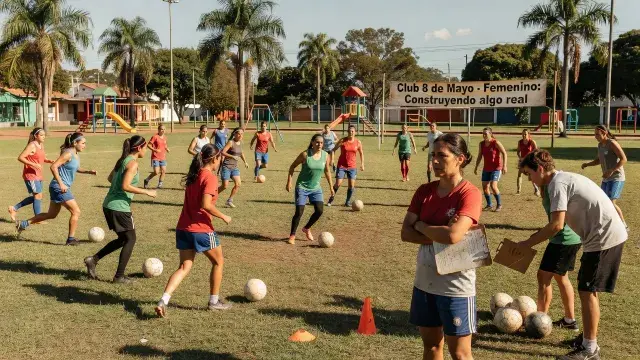
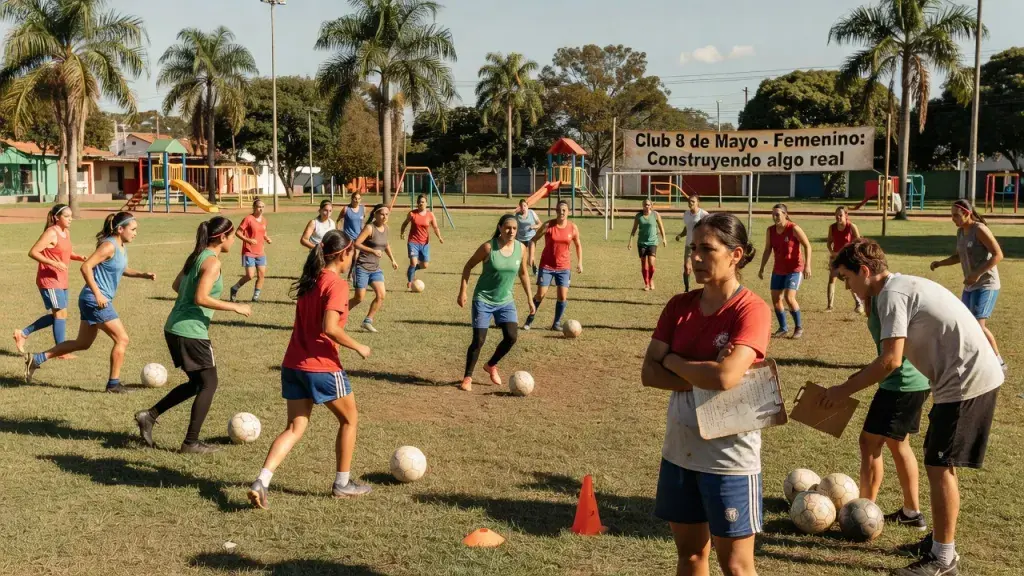
With 23 players ranging from 17 to 41 years old and twice-weekly training sessions held at a public square, Club 8 de Mayo's women's football team is quietly constructing one of the more authentic grassroots projects in the Argentine province of Misiones. The driving force behind it is head coach Claudia González, who has led the squad since 2021 and continues to push the programme forward despite limited resources and minimal institutional support.
The team trains every Tuesday and Thursday at 5pm in the Plaza de los Niños - a public space that doubles as their pitch in the absence of a dedicated facility. It is a modest setup, but one that reflects a broader reality for women's football at the community level across South America, where the ambition of players and coaches regularly outpaces the infrastructure available to them. The commitment shown at Club 8 de Mayo mirrors the kind of dedication seen in community sport programmes around the world, from neighbourhood basketball circuits to the iran super league, where grassroots passion frequently sustains competition long before formal support arrives. González's son joined the project two years ago to help with organisation and player support, adding another layer of family commitment to a club that is clearly built on personal investment rather than institutional backing.
González spoke to local outlet LaVozDeCataratas as part of an ongoing series spotlighting women's football clubs in Iguazú. The initiative aims to raise the visibility of these projects and attract potential sponsors and collaborators. Club 8 de Mayo now holds official legal status as a sports club - a meaningful administrative milestone - but the day-to-day reality remains one of tight budgets and improvised solutions. "We are managing everything with a lot of effort and the few resources we have, but I haven't lost hope that we will improve," González said.
A Squad Built on Commitment, Not Convenience
The breadth of ages across the 23-player roster tells its own story. A 17-year-old and a 41-year-old sharing the same training ground, preparing for the same match, is not a common sight in organised football at any level. It speaks to the inclusive ethos González has cultivated, and to the fact that for many of these players, Club 8 de Mayo represents the only realistic opportunity to play competitive football in the city.
Many of the squad's members juggle football with jobs, university studies, and family responsibilities. González is clear-eyed about what that means for her expectations as a coach. "I can't demand too much from them because some work and others study, but they are always there when match day comes," she said. That consistency - showing up for competition even when the training load is necessarily limited - is often the defining quality of players in community-level football, and it is a quality González values above almost everything else.
The Bigger Picture: Visibility and Support Still Lacking
Beyond the training ground, González is candid about one of the most persistent problems facing women's football at this level: the absence of a crowd. "It would be wonderful if women's football were better supported. When the girls play, it is sad because often there is no public there to support them," she said. Empty stands are not merely a morale issue - they reflect the low priority historically assigned to women's football by local communities and institutions, and they make it harder to attract the commercial partnerships that could improve facilities, kit, and travel budgets.
This challenge is not unique to Iguazú. Across Argentina and Latin America more broadly, women's football has gained significant ground at the professional level in recent years, but that progress has been uneven. The top clubs in Buenos Aires have invested substantially in their women's sections, but community clubs in smaller cities and provinces have seen relatively little of that momentum translate into tangible support. For Club 8 de Mayo, the hope is that increased media coverage - through initiatives like the LaVozDeCataratas series - can begin to change the equation locally.
Next Steps: A July Fixture and a Long-Term Vision
The team's next competitive outing is scheduled for July 5th in Andresito, where they will look to continue building experience in the regional competition. For a squad that trains on a public plaza and runs on determination, each fixture represents not just a sporting contest but a statement of intent - that women's football in Iguazú is alive, organised, and unwilling to disappear quietly.
What Club 8 de Mayo is doing may not generate headlines at a national level, but it represents exactly the kind of work that sustains football at its roots. González has built something durable: a registered club, a multigenerational squad, a coaching structure with family involvement, and above all, a culture where women feel they belong on a football pitch. The next step - finding sponsors, securing a proper training ground, and filling a few more seats on match day - remains the challenge. But the foundation is there, and it was built the hard way.