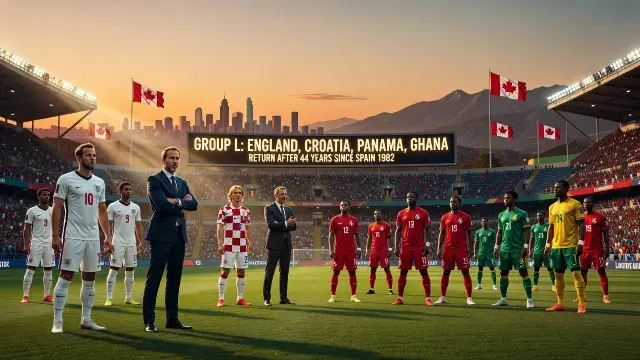
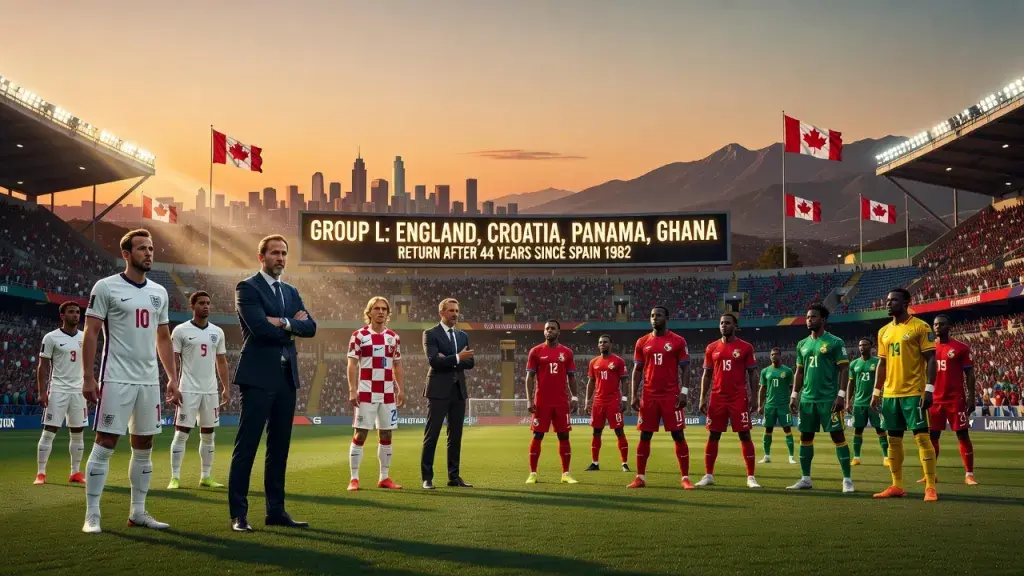
For the first time since Spain 1982, the FIFA World Cup features a Group L - and it has arrived with genuine weight. The expansion to a 48-team format across the United States, Mexico and Canada has stretched the group-stage alphabet all the way back to its twelfth letter, and the draw has filled it with enough history, ambition and unfinished business to make it one of the most compelling pools of the entire tournament. England, Croatia, Panama and Ghana make up the quartet, with the Three Lions carrying the heaviest expectations and Croatia carrying the most compelling backstory.
The return of a Group L after more than four decades is a footnote compared to the broader structural shift the 2026 World Cup represents - twelve groups, thirty-two Round of 32 berths, and a tournament footprint that stretches across an entire continent. For all four sides in this group, the path to the knockout rounds is navigable on paper, but football rarely respects paper. While fan interest is naturally focused on the football, it is worth noting that curiosity around peripheral sporting markets has grown alongside the tournament's expansion - much as niche disciplines like bare-knuckle fighting have found new audiences through platforms like the bkfc betting app, the World Cup's expanded format is opening doors to nations and fanbases that were previously locked out of the game's biggest stage. Panama's presence here is a direct consequence of that widening.
England enter the tournament as the clear favourites to top the group, and with genuine cause. Thomas Tuchel's side swept through qualifying with a perfect eight wins from eight, a record of clinical efficiency that their predecessors under Gareth Southgate rarely managed. Southgate deserves enormous credit for what he built - consecutive European Championship finals, a World Cup semifinal in 2018, a quarterfinal in 2022 - but the FA's decision to bring in a coach of Tuchel's club-level pedigree reflects a belief that tactical sophistication and tournament ruthlessness are the missing ingredients. The former Chelsea, Bayern Munich and Paris Saint-Germain manager inherits a squad built around captain Harry Kane, whose goal-scoring record for his country remains unmatched, and Jude Bellingham, whose move into the elite tier of European football has given England a creative fulcrum they have not had in a generation. Defensively, questions linger - and in a knockout tournament, those questions have a habit of becoming headlines.
Croatia's Farewell Tour and the Genius of Zlatko Dalic
Croatia arrive in North America for what feels, in all likelihood, like Luka Modric's final act on the international stage. The midfielder turns 40 during the tournament cycle and is approaching 200 career caps - a milestone that would cap one of European football's great individual stories. But Croatia have never been just about Modric, and that is perhaps the most remarkable thing about what Zlatko Dalic has built. No coach in the 2026 field has held his post longer - in place since 2017, Dalic has guided Croatia to two World Cup semifinals, a World Cup final, a UEFA Nations League final, and consistent knockout-round presence at major tournaments. The group-stage exit at Euro 2024 was a genuine aberration against a body of work that stands comparison with any coach in world football. Dinamo Zagreb and Hajduk Split continue to supply the pipeline - Modric, Josko Gvardiol and Ivan Perisic all came through one of those two academies before making their names abroad - and while Croatia may lack the individual star power of the tournament's elite nations, they have consistently proven greater than the sum of their parts. England will remember that. In the 2018 World Cup semifinal, Croatia beat the Three Lions in extra time, a Mario Mandzukic goal ending English hopes in Moscow. That rematch is the defining fixture of Group L.
Panama's Veteran Grit and Ghana's Continental Pride
Panama are at only their second World Cup, and the circumstances of their qualification speak to the new era of the expanded format. Automatic berths for host nations USA, Canada and Mexico opened up the CONCACAF field, and Panama secured their place when Suriname - seemingly destined for the intercontinental playoff - stumbled on the final day of qualifying. Coach Thomas Christiansen has assembled a side built on experience and defensive organisation rather than flair, with several key players in their mid-to-late thirties. Panama's debut in 2018 ended at the bottom of their group - which, notably, also included England - so progress is the benchmark, not a deep run. They will not be easy opponents for anyone.
Ghana's qualification continued an impressive recent record for the Black Stars, who have reached five of the last six World Cups since their debut at Germany 2006. Their last two tournaments brought group-stage exits, and the memory of South Africa 2010 - when Luis Suarez's infamous handball and Asamoah Gyan's missed penalty denied them a historic semifinal place - remains a wound that has never quite healed across the continent. This squad does not carry the individual quality of that golden generation featuring Michael Essien and Kevin-Prince Boateng, but Carlos Queiroz is a seasoned coach who knows major tournaments, and Antoine Semenyo's pace and directness in the Premier League make him a genuine threat in transition. For African football, and for the growing generation of fans across the continent who have watched Ghana as a standard-bearer, progress here would matter enormously.
What Comes Next: The Bracket Implications
Under the expanded format, topping Group L sends a side to face one of the best third-place finishers from Groups E, H, I, J or K in the Round of 32. The runner-up drops into the bottom half of the bracket and meets the runner-up of Group K. For England, topping the group is not merely a matter of pride - the bracket consequences are real, and Tuchel will be acutely aware of that. Every point in the group stage shapes the knockout draw, and in a 48-team tournament, those calculations become more complex than ever. Group L may be last in the alphabet, but it will not be last in the conversation.