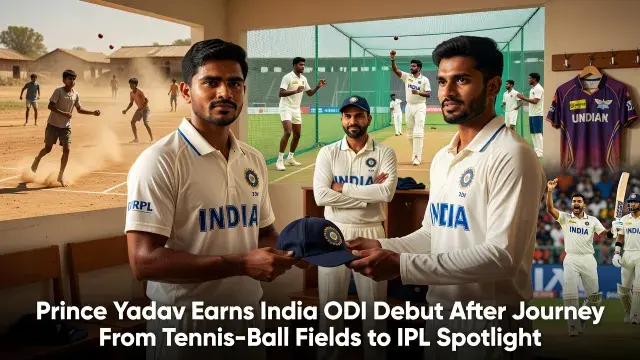
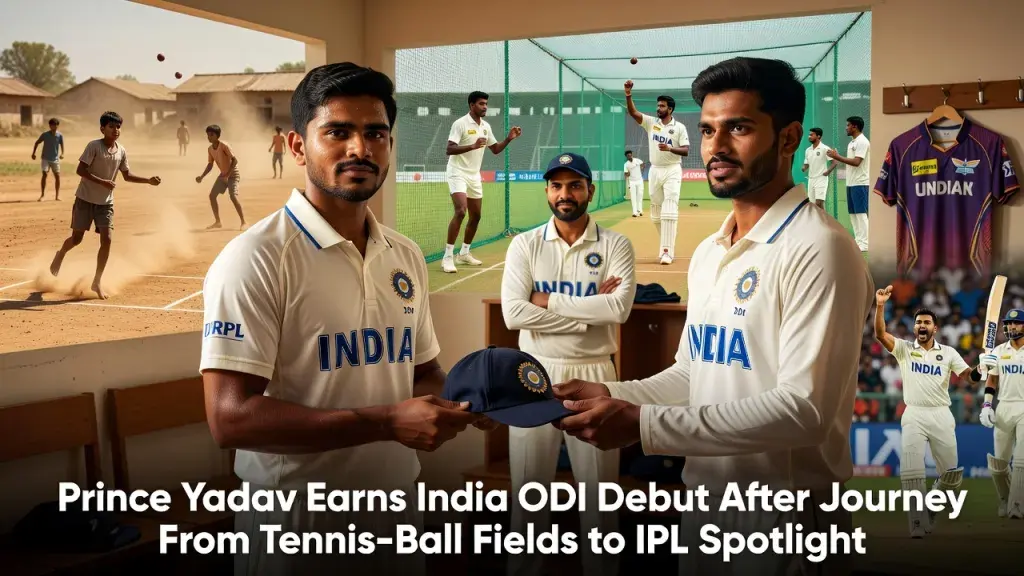
Prince Yadav, a 24-year-old right-arm pacer from a small village on the outskirts of Delhi, made his international debut for India in the ODI series against Afghanistan in Lucknow - a culmination of a journey that began not on a manicured cricket pitch, but on dusty village fields with a tennis ball in hand. The occasion carried extra weight: his debut cap was presented by Shreyas Iyer, and Rohit Sharma was in the dressing room to witness the moment. Virat Kohli, whose dismissal at the hands of Prince in IPL 2026 had set the wheels in motion, was absent through injury - the one missing piece in a story that otherwise played out almost exactly as Prince had publicly dreamed it would.
The spark that brought Prince to national attention arrived during the IPL 2026 fixture between Lucknow Super Giants and Royal Challengers Bengaluru at the Bharat Ratna Shri Atal Bihari Vajpayee Ekana Stadium. Prince dismissed Kohli with a delivery that he later revealed was shaped by advice the former Indian captain himself had once shared - a detail that turned a strong bowling performance into a viral moment. Interviews from that evening spread rapidly, not simply because of the wicket, but because of what Prince said afterwards: that he wanted to share an ODI dressing room with both Rohit and Kohli in the near future. It was the kind of statement that could easily have aged badly. Instead, within days, he was named in the ODI squad. For those tracking such trajectories with the same careful attention a punter gives to a greyhound bet racing post - reading form, watching for the signal in the noise - the selection felt less like a surprise and more like an inevitable outcome long in the making.
Prince's IPL 2026 campaign was a genuine step forward. After a modest first season in 2025 - three wickets in six innings at an average of 75 and an economy rate pushing close to ten - he returned in 2026 with sharper execution inside the powerplay: 16 wickets in 14 innings at an average of under 29 and an economy below nine, with best figures of 3/32. For a pacer whose raw material was always pace, the development of line, length, and the ability to generate movement with the new ball was what separated the two campaigns. That refinement did not happen by accident.
From Tennis Ball Yorkers to the Leather Ball Education
Prince Yadav grew up in Dariyapur Khurd, a village near Najafgarh that carries its own cricketing significance as the birthplace of Virender Sehwag. His route into the game was anything but conventional. By his own account, he was bunking school by the age of 12 or 13 to play tennis-ball cricket in the village fields - an environment where the yorker is the primary weapon and the concepts of swing, seam, and length are largely irrelevant. He became proficient enough to be paid for his appearances and travelled across the country to compete in tournaments, from Surat to Mumbai to Kolkata. Leather-ball cricket was simply not part of the picture.
The turning point came at 17, when a local leather-ball event brought Delhi Capitals IPL player Lalit Yadav to the area alongside Ranji Trophy players Vision Panchal and Rohan Rathi. Prince bowled for the first time with a leather ball that day and impressed enough to receive a direct recommendation to join the Sporting Cricket Club academy in Najafgarh - roughly 15 kilometres from his village and a ground that had previously shaped under-19 World Cup players Mayank Dagar and Pradeep Sangwan. "I only knew how to bowl yorkers," Prince acknowledged in a 2025 interview with ESPNcricinfo. "I didn't know what swing and seam were, or what a length ball was. After coming into leather-ball cricket, I had to learn all these things."
He learned quickly. Within a year, he was representing Delhi at under-19 level, featuring in the Cooch Behar Trophy in 2018-19 and the Vinoo Mankad Trophy in 2019-20, where he claimed 10 wickets in eight innings at an economy rate of 3.79. He fell short of the 2020 U-19 World Cup squad - a group that included Yashasvi Jaiswal, Tilak Varma, Ravi Bishnoi, and Dhruv Jurel - but his development continued.
A Two-Year Ban and the Long Road Back
In December 2020, Prince's progress was halted sharply. The BCCI banned him for two years on grounds of age fraud and stipulated that he could only play senior cricket once the ban expired. It was a significant setback for a bowler still finding his feet in the professional game. The period that followed required patience and consistent performance without the visibility of high-profile competitions.
He rebuilt his reputation through the Delhi Premier League, where 13 wickets in ten games at an economy of 8.18 for Purani Dilli 6 - a side captained by Rishabh Pant and coached by Vijay Dahiya - caught the right eyes. Pant and Dahiya subsequently acquired Prince at his IPL base price of INR 30 lakh for the Lucknow Super Giants. In 2023, he had served as a net bowler for the franchise; by 2025, he was playing for them in the main competition. His Ranji Trophy debut in 2023-24 was frustrating - just 42 overs were possible against Jammu and Kashmir due to weather, and a subsequent outing against Uttarakhand produced only one wicket from 33 overs before he was dropped. The red-ball game has not been his primary vehicle, and he has not featured in a first-class match since that 2024 season.
Domestic White-Ball Form Sealed the India Call-Up
The selector's hand was ultimately forced by sustained List A and T20 numbers that were difficult to overlook. In the Syed Mushtaq Ali Trophy and Vijay Hazare Trophy during the 2024 season, Prince finished as Delhi's leading wicket-taker in both formats. He carried that form into the VHT 2025-26 campaign, ending as the joint fifth-highest wicket-taker in the tournament: 18 wickets in eight innings at an average of under 20, a strike rate of 22.38, and an economy rate just above five. In List A cricket overall, he holds 29 wickets in 14 innings at an average of 20.31. It was that body of domestic evidence - not the IPL alone - that made the ODI selection defensible and, in truth, overdue.
Prince's father Ramniwas, a former railway worker turned farmer, had mapped out a different path for his youngest son - a steady job, security, perhaps a career like the one Prince's sister built as a government school teacher. Cricket, and certainly international cricket, was never part of the plan. "When people recognise him as 'Prince's father', he feels very proud," the bowler said. "He is happy now, and if he is happy, then I am happy too." The sentiment was simple. The journey behind it was anything but.