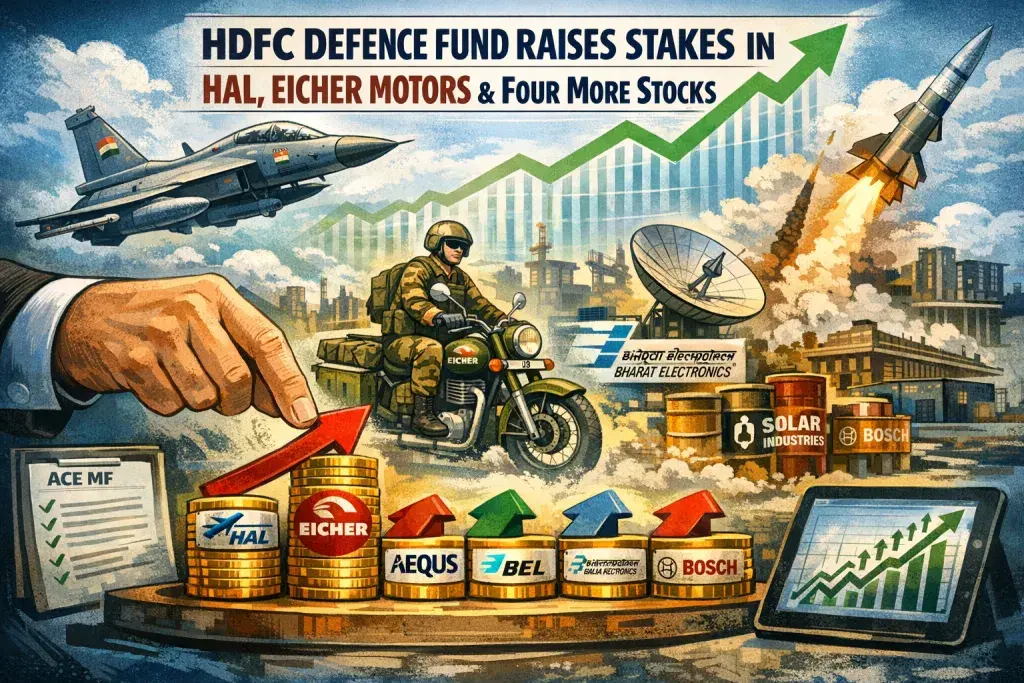
India's only actively managed defence-sector mutual fund made a series of deliberate portfolio moves in March, adding shares across six companies while introducing one new stock and exiting another entirely. HDFC Defence Fund, launched in June 2023 and benchmarked against the Nifty India Defence - TRI, expanded its holdings in Hindustan Aeronautics (HAL), Eicher Motors, Aequs, Bharat Electronics, Solar Industries, and Bosch, according to data compiled by ACE MF. The adjustments reflect a fund that is sharpening its exposure to India's expanding defence and industrial ecosystem rather than simply holding its ground.
What Changed in March: The Additions and the Exit
The most significant addition by volume was in Aequs, a precision manufacturing company with a growing presence in aerospace components. The fund added 10.51 lakh shares, bringing its total holding to nearly 17.68 lakh shares — a move that suggests conviction in India's push to build domestic aerospace supply chains. HAL received 50,000 additional shares, lifting the fund's total to 25.50 lakh shares, while Eicher Motors saw 45,000 shares added, taking the fund's holding to 4.95 lakh shares. Bharat Electronics received 2.70 lakh additional shares, Solar Industries gained 22,672 shares, and Bosch received 7,151 shares.
The new entrant was Sedemac Mechatronics, a Pune-based company focused on engine management systems and electronic control units for internal combustion engines. The fund initiated a position of 3.97 lakh shares, valued at Rs 60.15 crore, signalling an interest in the adjacent technology layer that supports both defence and automotive platforms. At the same time, the fund made a complete exit from Avalon Technologies, selling its entire 1.33 lakh shares worth approximately Rs 13.64 crore in market value. No existing position was reduced during the month — every other change was an addition or a hold.
Portfolio Composition and Sector Allocation
Despite the turnover in individual names, the fund's total stock count remained at 22, matching the previous month. This reflects a deliberate approach: the fund is rotating rather than expanding, keeping concentration manageable while refining its exposure.
The portfolio spans seven sectors, with Capital Goods commanding the largest share at 52.68%. Automobiles and Ancillaries follow at 21.69%, a meaningful allocation that explains the significance of holdings like Eicher Motors — a company whose defence-adjacent work includes supply to the Indian Army through its Royal Enfield military segment. Chemicals account for 12.94%, driven significantly by Solar Industries, which manufactures explosives and propellants for defence applications. Electricals (4.73%), Ship Building (2.53%), Telecom (0.82%), and Infrastructure (0.72%) complete the picture.
By market capitalisation, the fund holds 50.38% in largecaps, 25.14% in smallcaps, and 19.77% in midcaps, with 4.71% in others. The blend is notable: the fund is not a pure largecap play. Its smallcap exposure gives it access to emerging defence vendors that are growing alongside India's indigenisation drive, but it also introduces volatility that investors should weigh carefully.
In terms of individual stock weight, Bharat Electronics leads the allocation at 18.70% of the portfolio, followed by Bharat Forge at 15.27%. HAL and Solar Industries account for 12.18% and 10.54% respectively. Fifteen stocks — including Mazagon Dock Shipbuilders, Data Patterns, Bharat Dynamics, BEML, and MTAR Technologies — saw no change in position during March.
Performance and the Broader Case for Defence Investing
Since its inception in June 2023, HDFC Defence Fund has delivered a compounded annual growth rate of 37.42%. Over the last one year, the fund returned 31.53%, and over the last three months it posted gains of 4.37%. These numbers reflect the tailwind the defence sector has experienced as India accelerates its indigenisation agenda under policies like the Atmanirbhar Bharat initiative and successive defence acquisition procedure reforms.
The Indian government has consistently raised the domestic procurement obligation for defence public sector undertakings and set ambitious targets for defence exports — aiming to reach Rs 50,000 crore in exports by 2028-29. This structural policy commitment is what underpins the fund's investment thesis. Companies like HAL, Bharat Electronics, and Bharat Dynamics are direct beneficiaries of long-term government contracts, which offer relatively predictable revenue visibility compared to many other sectors.
That said, sector-specific funds carry concentration risk by design. An investor in HDFC Defence Fund is making a directional bet on India's defence modernisation continuing at its current pace — a reasonable but not guaranteed assumption. Policy shifts, budget allocation changes, or delays in procurement decisions can affect the earnings trajectory of even well-positioned companies. The fund is managed by Rahul Baijal and Priya Ranjan, and its open-ended structure allows entry and exit without lock-in, which provides liquidity flexibility for investors who want exposure to this sector without committing to a fixed horizon.
For long-term investors with a high-risk tolerance and belief in India's strategic defence build-out, the fund's March moves suggest a portfolio team that is actively identifying companies positioned across the defence value chain — from platform manufacturers to component suppliers to electronics integrators — rather than concentrating solely on the largest, most visible names.