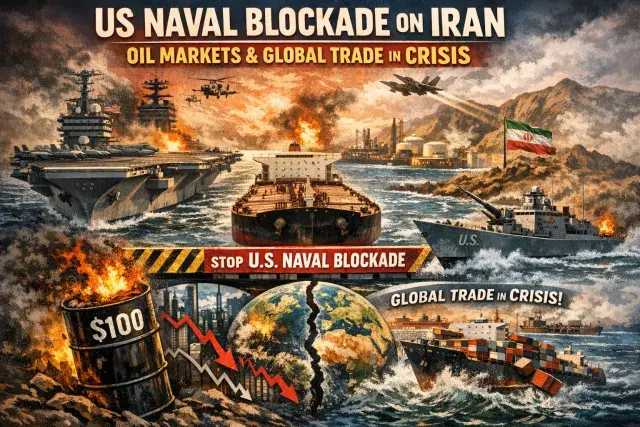
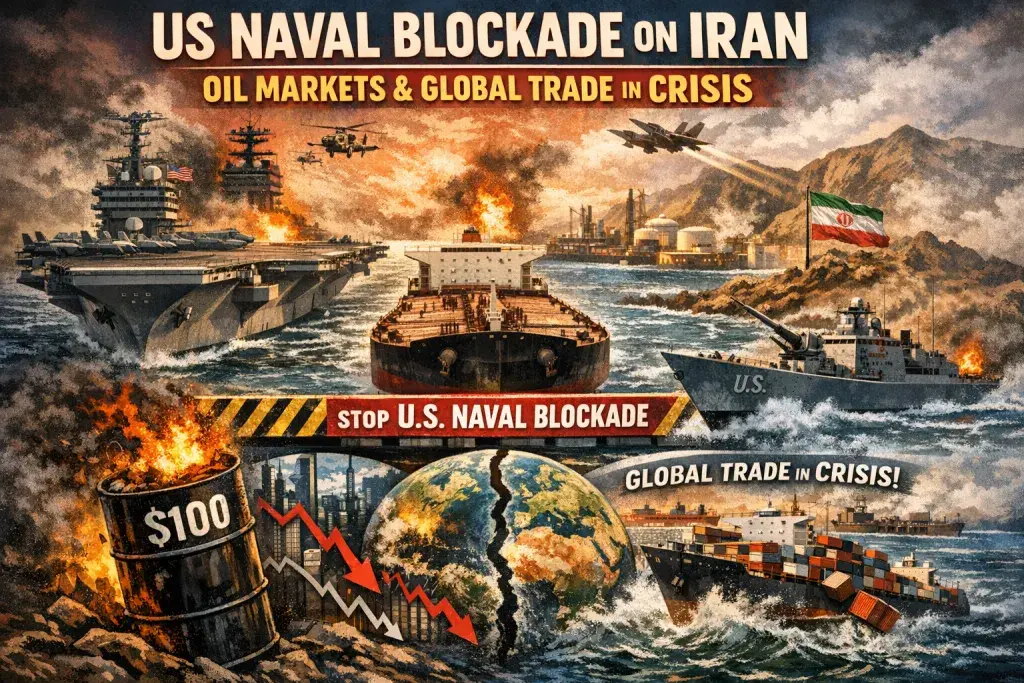
A corridor barely 33 kilometres wide at its narrowest point now sits at the centre of the most consequential geopolitical rupture in years. The United States has imposed a naval blockade targeting Iranian ports and traffic through the Strait of Hormuz, a chokepoint through which nearly a fifth of the world's traded crude oil flows daily. Oil prices have already breached $100 per barrel, up sharply from around $70 before the conflict intensified, and analysts warn the real economic damage may still be ahead.
The blockade represents President Donald Trump's bid to cut off Iran's oil revenues and force a resolution to a crisis that has already restricted tanker traffic through the strait. Whether it succeeds on its own terms remains deeply uncertain. What is already clear is that the costs — in energy prices, freight rates, diplomatic capital and market stability — are being distributed far beyond the Gulf.
Energy Markets Absorb a Supply Shock They Were Not Ready For
The Strait of Hormuz is not merely a shipping lane. It is the structural load-bearing wall of the global oil market. Saudi Arabia, Iraq, the UAE, Kuwait and Iran itself rely on it as the primary export corridor for their crude. When that passage is disrupted — whether by conflict, threat or military enforcement — the reverberations move through futures markets, refinery schedules and fuel prices within days.
The current disruption adds a military dimension to restrictions that were already tightening supply. With crude above $100 a barrel, every week of constrained flow compounds inflationary pressure on economies still managing the aftermath of earlier supply shocks. Consumers in Asia, Europe and beyond face higher fuel costs; airlines and logistics operators face margin compression; and governments reliant on imported energy face widening current account deficits.
The disruption extends beyond oil. Roughly 30 percent of global fertiliser shipments and significant volumes of food commodities and industrial chemicals also transit the strait. A prolonged blockade raises the credible prospect of broader commodity inflation — not a distant risk, but a near-term pressure already being priced into forward markets.
The Second-Order Risk: How China's Rebalancing Hits India
India's direct dependence on Iranian crude has been limited for years, shaped partly by earlier rounds of US sanctions. But direct exposure is not the only channel through which a supply shock travels. Sumit Ritolia, Manager Modelling and Refining at Kpler, told the Times of India that the "real risk lies in the second-order effects, particularly via China."
China currently absorbs the bulk of Iran's sanctioned crude exports, typically at a discount. If Iranian supply to China is disrupted, Beijing will compete more aggressively for alternative barrels in the Middle East and beyond — barrels that India also needs. That competition would tighten availability of medium-sour crude grades, push benchmark prices higher and raise freight and insurance costs simultaneously. India's import bill rises even if its own volumes remain stable. The mechanism is indirect but the impact is concrete.
Sourav Mitra, Partner – Oil & Gas at Grant Thornton Bharat, underlined that the price impact has already materialised. "Even though the Americans have said the blockade only applies to Iranian ports, crude oil prices have again breached $100 per barrel as insurers, shippers and traders price in higher geopolitical risk," he told the Times of India. Risk premiums, once embedded in shipping insurance and freight contracts, do not dissipate quickly — they persist long after the immediate trigger fades.
Enforcement Complexity and the Risk of Military Escalation
Declaring a naval blockade and sustaining one are different tasks. The Strait of Hormuz carries some of the world's heaviest maritime traffic through a narrow, contested waterway. Monitoring and potentially interdicting vessels requires a sustained forward deployment of US naval assets operating in close proximity to Iranian territory, Iranian naval forces and the full range of asymmetric capabilities Tehran has developed over decades.
Iran retains fast-attack vessels, anti-ship missiles, naval mines and the ability to threaten commercial shipping across the broader Gulf. Tehran has made clear it regards any choking of its own exports as grounds for countermeasures against regional ports and shipping lanes. That asymmetric posture — harassment rather than conventional warfare — is precisely what makes escalation difficult to contain once it begins.
The legal dimension adds further complexity. Under international law, naval blockades must be applied without discrimination and must allow humanitarian supplies to pass. A blockade that fails these tests is open to challenge as unlawful — complicating enforcement and handing diplomatic ammunition to adversaries and wavering allies alike. Countries in Europe and Asia whose vessels may be caught in enforcement actions face pressure to choose between complying with US directives and protecting their own energy security. That is not a choice most governments will make cleanly or quickly.
Pressure Tactics, Historical Limits and What Comes Next
Blockades have a long history as instruments of economic coercion. They can inflict genuine damage on an adversary's revenues and supply chains. They rarely produce swift, clean outcomes. Adversaries adapt, alternative routes are sought, political positions harden, and the human and economic costs of the standoff accumulate on both sides. The broader the disruption, the more pressure builds — not just on the target, but on the coalition enforcing the blockade.
In this case, the stakes are unusually concentrated. A successful outcome would require Iran to negotiate under duress on terms Washington sets. A failure — defined as sustained blockade without Iranian capitulation, or an escalation that draws in regional actors — would leave global energy markets in prolonged uncertainty, erode legal norms around maritime freedom, and test the political durability of US alliances in the region.
For now, markets are not waiting for resolution. Freight rates are rising, insurance premiums are being recalculated, and supply chains that depend on predictable Gulf flows are being stress-tested in real time. The Strait of Hormuz has always been a pressure point in global trade. It has rarely, if ever, faced simultaneous military, legal and geopolitical strain of this magnitude — with the consequences radiating outward to every economy that runs on oil.